
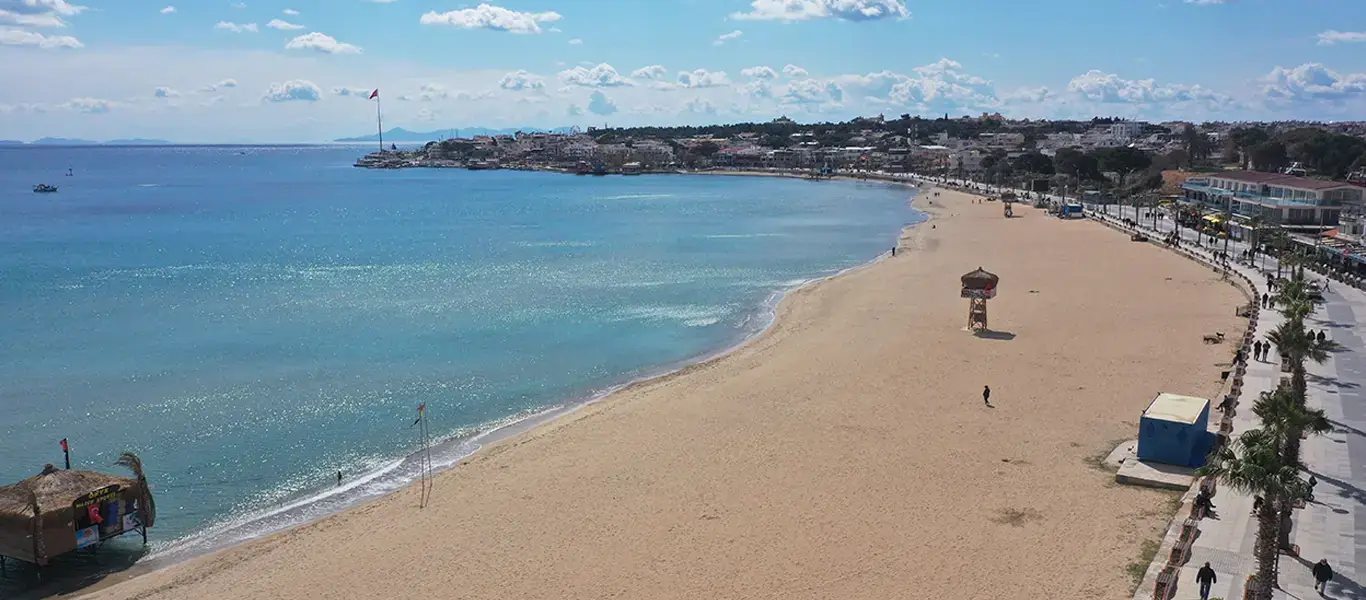
Because of its location, Didim has witnessed civilisations that left a deep mark on history, making it a place of great geopolitical and cultural importance. The Western world often traces civilisation back to the Greeks, yet Anatolia has always absorbed the cultures that reached it and forged something uniquely its own.
Known in Ottoman times as “Yoranda” or “Yoran”, the area was renamed “Yenihisar” after the 1955 earthquake, when its people moved into new houses built by the state. Later, to avoid confusion with places of the same name, it took the name Didim, which exists nowhere else and goes back to the ancient temple of “Didymaion”.
Where the oracle began: Branchus and Apollo
In antiquity, the gift of prophecy was believed to come from Apollo, son of Zeus and Leto and god of the sun, light, music and prophecy. Some scholars argue that Apollo’s origins go back to Hittite Anatolia.
Legend has it that Apollo once came across Branchus, a shepherd in the Didim area. Taken with the young man, the god taught him all the secrets of prophecy. Branchus founded the first temple to Apollo beside a laurel grove and a sacred spring, on the spot where the Temple of Apollo stands today. His descendants, the Branchidae, ran the sanctuary for generations, and the area was long known as “Branchidai”, the land of the Branchidae.
King Croesus and the oracles
In the ancient world, Didyma (“the twins”, after Apollo and Artemis) was one of the most important oracles, consulted by everyone from kings to the poorest farmers. Even Croesus, the fabulously rich king of Lydia, tested the oracles of his day before going to war with Persia.
Trusting the oracles’ cryptic verses, Croesus attacked Persia – and learned the hard way that the prophecy that “a great empire will fall” referred to his own. It was the kingdom of Lydia that fell.
Destruction and rebirth: the temple that was never finished
It is a striking contrast that oracles were so powerful in Miletus, the cradle of rational philosophy. The first era of sacred Didyma ended when the Persians captured Miletus and sacked the sanctuary: after the naval Battle of Lade in 494 BC, the famous bronze statue of Apollo was carried off to Ecbatana in Persia.
The sanctuary revived with the arrival of Alexander the Great, and around 300 BC work began on a new temple with the support of Seleucus, one of Alexander’s generals and later king of Syria, who also returned the stolen statue. The architects of this vast Hellenistic project were Daphnis of Miletus and Paeonius of Ephesus.
Measuring some 109 × 51 metres at its base, the temple took centuries to build, slowed by wars and money troubles, and was never truly finished. As the archaeologist George Bean noted, marks scratched into the walls recording the workers’ wages can still be seen today. Many historians agree that, had it been completed, the Temple of Apollo might have ranked among the Seven Wonders of the World.
The Sacred Way from Miletus to Didyma
In antiquity Didyma was linked to Miletus by a Sacred Way about 17 kilometres long. Pilgrims and processions walked this road to the sanctuary, past seated statues of Branchid priests and benefactors. Several of these statues were taken to London in the 19th century and can be seen today in the British Museum.
Visiting the Temple of Apollo
The temple stands in Didim town centre, about 10 minutes by car from Altinkum. As you wander among its giant columns, don’t miss the Medusa head relief that has become a symbol of the site. In summer, go early in the morning or towards sunset to avoid the midday heat, and check the Turkish Ministry of Culture and Tourism for current opening hours and admission fees.
For the nearby ancient cities of Miletus and Priene, see our things to do in Didim page.
If you would like to see contemporary art inspired by this land, a source of art and inspiration since antiquity, you can find the work of painter Yıldız Demir at Yıldız Demir Artworks.