
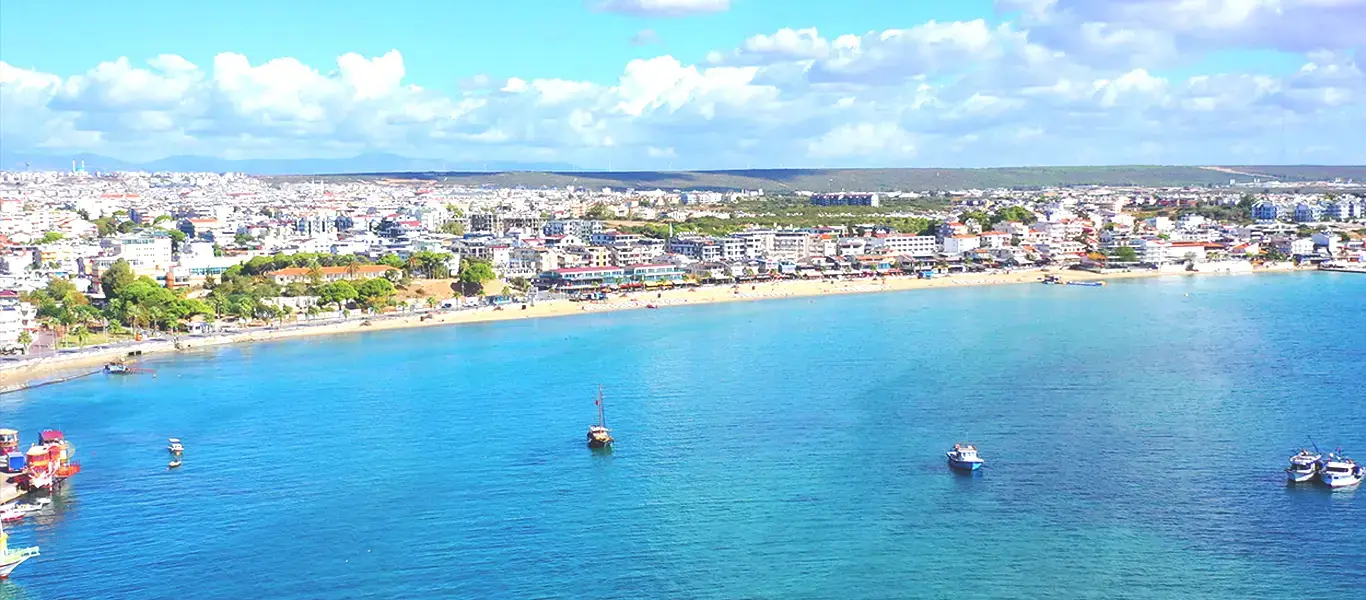
Didim became a district in its own right in 1991. It is a peninsula of roughly 400 km², bordered by Akbük Bay and the province of Muğla to the east, the Aegean Sea to the west and south, and Lake Bafa and the Büyük Menderes (Maeander) river to the north.
This remarkable stretch of coast runs from the mouth of the Büyük Menderes down to Akbük Bay in the south, with world-famous Altinkum on its western side and green, wooded Akbük to the east.
In the footsteps of history: from Yoran to Didim
Thanks to its location, the area has been home to many ancient civilisations. In Ottoman times the settlement was known as “Yoranda” or “Yoran”. After the 1955 earthquake its people were moved into new houses built by the state, and the town became “Yenihisar”. Later, to avoid confusion with other places of the same name, it took the name Didim, from the ancient “Didymaion”, a name found nowhere else in the world.
The ancient city of Miletus, where the Büyük Menderes once met the sea, lies only about 25 km from today’s Didim. You can read the story of the Temple of Apollo and its oracle on our Didim history page.
Getting there
Didim is well connected by road. Approximate distances to key places:
- Söke: 55 km
- Milas: 80 km
- Aydın city centre: 125 km
- İzmir: 175 km
- Ankara: 700 km
If you are flying in, the nearest airport is Bodrum-Milas (about 1.5 hours by road); İzmir Adnan Menderes Airport is about 1 hour 45 minutes away.
Altinkum and its natural setting
The district is covered in the maquis scrub typical of the Mediterranean. Didim is known for its coastline of around 60 kilometres, countless coves large and small, and 13 kilometres of uninterrupted beach.
Blue Flag Altinkum beach, with its fine golden sand and crystal-clear water, has made the area a magnet for Turkish and international visitors alike. Didim is also a favourite for second homes, especially among people from the UK looking for a life close to nature. For more on the beaches, see our Altinkum beach page.
Fertile land and olive growing
With the fertile Söke plain to the north and the blue Aegean to the south, Didim is rich in farming as well as tourism. Olive trees, symbols of wisdom and health since antiquity, are among the most precious treasures of this land, and the region’s clay and stony soils have a direct effect on the quality of its olive oil.
To taste this fertile land at your own table and try high-polyphenol local olive oil, take a look at Uzakköy. We cover the region’s olive culture, the harvest and the Memecik olive on our Olive Growing in Didim page.