
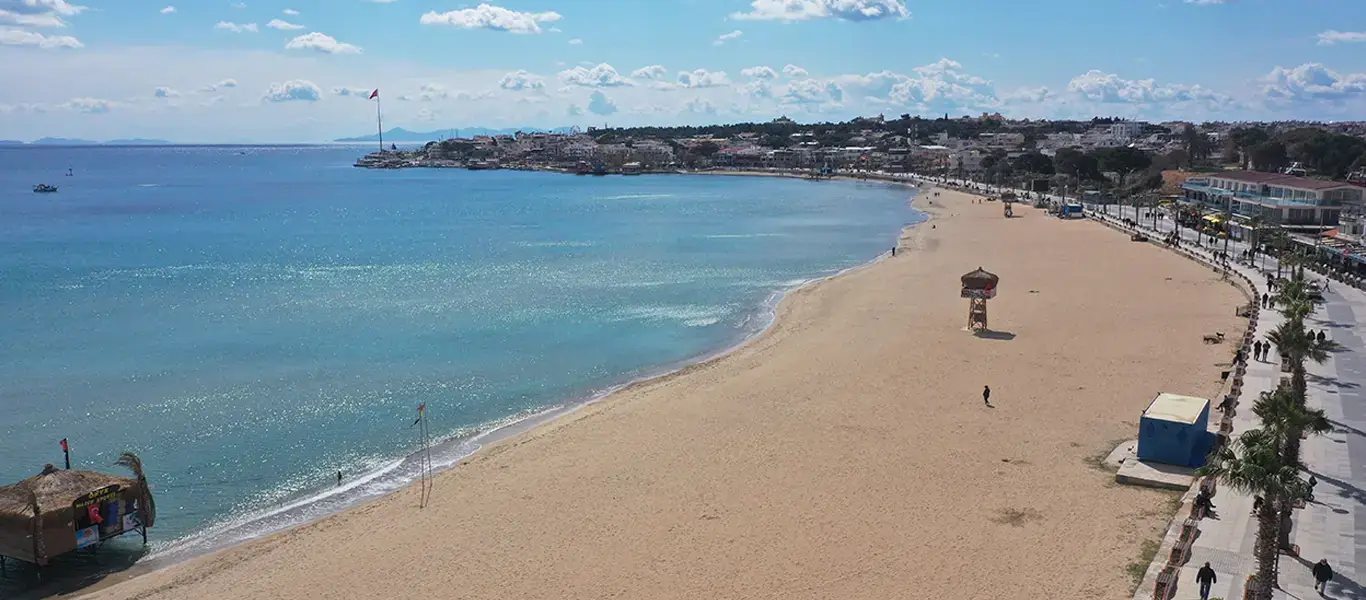
Rather than spending your whole stay in Altinkum on the beach, set aside a few days to explore. The Temple of Apollo at Didyma may be the closest historic site, but the whole area is a paradise of ancient cities and natural beauty. Here are the places to add to your Didim itinerary:
Akbük: where green meets blue
For a peaceful holiday away from the crowds, where the blue sea meets green forest and the air is clean, Akbük is hard to beat. Set along about 11 kilometres of coastline, it is known for its woodland and is ideal for all kinds of water sports. With its hotels, guesthouses and amenities, it has the feel of a modern seaside town.
Akköy and birdwatching
The lagoons around Akköy (often written Akkoy), on the old bed of the Büyük Menderes, are an important destination for nature lovers and ornithologists. They are home to countless species, including the threatened Dalmatian pelican, flamingos and, above all, kestrels.
Every year around late March and early April, kestrels return from Africa to breed under the eaves of the village’s traditional stone houses. By hunting grasshoppers, scorpions and snakes they keep nature in balance, and they are one of the main reasons Akköy has never suffered a plague of pests. It is common to see birdwatchers from the UK, Canada and around the world with their cameras and binoculars in Akköy’s old cobbled streets. Akköy is also the heart of the area’s olive growing, surrounded by olive groves.
Getting to Akköy: All minibuses on the Didim–Söke route pass through Akköy. If you are driving from the Söke direction, turn at the sign for Miletus (via Akyeniköy). The village streets are narrow and old, so it is best to park in the village square and explore on foot.
Lake Bafa Nature Park
Lake Bafa was once a bay of the Aegean. Silt carried by the Büyük Menderes gradually cut it off from the sea and turned it into a lake. About 30 km by road from Didim town and only around 10 km from Akköy, the lake covers some 7,000 hectares and is surrounded by Mediterranean vegetation, olive groves and pine forest.
Up to 25 metres deep, the lake is dotted with islands, such as İkiz Ada, Menci Island and Hayalet Ada, many of them with historic ruins. Listed as an internationally Important Bird Area, Lake Bafa feeds and shelters thousands of waterbirds in winter.
Getting to Lake Bafa: Get off at the town of Bafa (Çamiçi) on the Milas–Söke road to reach the lake. To get to Kapıkırı village and the ruins of ancient Herakleia (about 11 km off the main road), it is worth asking locals or businesses in town for help.
Ancient Miletus
Miletus stands out for spreading over a much larger area than the other ancient cities nearby. Its grandest building, the Theatre of Miletus, is one of the finest examples of Greco-Roman architecture. It seated 5,300 people in the Hellenistic period, rising to more than 15,000 under the Romans.
Today the remains of a Byzantine and Ottoman fortress crown the top of the theatre. Through the galleries behind it you reach the harbour area – the only one of the city’s four great harbours to survive – marked by a monument carved with a Triton, half man and half fish.
Ancient Priene
Priene was one of the leading cities of Ionia, the region that Herodotus, the “father of history” and himself an Anatolian, described as having “the fairest sky and climate of any place we know”. Refounded in the mid-4th century BC on the grid plan associated with the Milesian architect Hippodamus, it is considered a masterpiece of Hellenistic town planning.
Because the people of Priene ran the “Panionion” festival, the religious and political gathering of the twelve Ionian cities, it was one of the most respected cities of its time.
What to eat: local flavours
Seafood: On the beaches of Altinkum and Didim, fresh Aegean fish comes first. You will find excellent fish restaurants all along the seafront, and you can also enjoy a seafood feast surrounded by nature on the Akbük coast and in the Karina area.
Village breakfasts and eel: At the rustic places on the shores of Lake Bafa you can enjoy a legendary Aegean village breakfast and try the eel the area is famous for.
Local touches: While exploring Akköy’s historic streets, stop at a village coffee house and pick up homemade wine and genuine Aegean olive oil made by the villagers themselves. For a quick bite, the centre and seafront are full of kumpir (stuffed baked potato), gözleme and döner stalls.
On a boat trip you will usually be served fresh fish or a barbecue cooked on board after a swim in the cool Aegean.