|
AKBUK
|
Akbuk is located in the centre of Turkey’s favourite coastline, 70km from Bodrum
Airport, 65km from Kusadasi and 18km from Didim.
The perfect location set in a
beautiful natural environment by the sea, surrounded by protected forests and
olive trees.
Akbuk is also said to have the highest oxygen ratio and lowest
humidity rate in Turkey.
|
 |
Not only is there a rising trend for real estate in Akbuk, but this is
becoming a popular tourist destination too. Already you can find restaurants,
bars, holiday complexes, summer houses, villas, and hotels. Not to mention the
beautiful harbour which boasts golden sands and clear blue water, the perfect
welcome as you arrive in Akbuk.
You can visit the resort by local minibus (Dolmus). The service runs daily in
and out of Altinkum and operates approx every 20 minutes.
Akbuk became a township in 1991 and is developing according to plan. Most of the
infrastructure is complete, new buildings, clean roads, clean beaches and
pedestrian walkways by the harbour.
Tour Operators have researched Akbuk, but it still remains relatively
undiscovered compared to busier resorts such as Altinkum and Kusadasi. Tourism
within Akbuk has also provided great opportunities for locals too. With the
demand for boat trips around the coastline, local fisherman use their boats to
provide daily boat trips for the holiday makers throughout the summer months.
Akbuk is an unspoilt resort with something to suit everyone. Whether it be
water sports, a visit to the local chapel on the coastline or just lazy days by
the sea, combined with the local hospitality and traditional cuisine, Akbuk will
leave a lasting impression on all those who visit.
AKKOY
Akkoy is a small traditional Greek Style village, 20 minutes from Didim. The
name of the village is derived from Turkish, as the local houses are made of
local white stone and Akkoy meaning ‘white village’.
|
Before 1922 Akkoy was home to 4000 Greeks, bought there from regions of Crete
and Peloponnesus. They were bought to Akkoy to compensate population decline due
to disasters such as earthquake, cholera and malaria. As they were already
experienced in growing tobacco they would also bring a new form of revenue to
Akkoy.
50 -60 years later the majority of the inhabitants returned to their homeland,
others resided in Akkoy, but eventually fled to Samos and other Greek Islands. |
 |
Apart from being the oldest village in the region, Akkoy also has the largest
village library in Turkey and is also where the local Gendarma station is
located.
Akkoy is also home to lots of wildlife including the Peregrine Falcon, kestrels,
Pelicans and Flamingos. If you visit Akkoy between the months of May and June
you can see the Peregrine Falcons on the roofs of the old Greek houses lining
the streets in the village.
As the Government is bringing in new laws regarding the amount of tobacco you
are allowed to grow, locals are looking at other possible forms of revenue. One
new idea comes in the form of Strawberry farming. There is one you can visit at
Trasburun, just outside Akkoy owned by Mr. Ali Olgun, he is not just a pioneer
of Strawberries but also rears Ostrich on his farm!
Thursday is market day in Akkoy, where you can sample local cheese, village
wine and traditional locally made Gozleme. The locals are very welcoming and
hospitable but as this is a village and not a holiday resort, visitors to the
village are advised to dress accordingly.
PAMUKKALE
Pamukkale, known by Turkish people to be the 8th wonder of the world, is located
19km from Denzili in the inner Aegean region of Turkey.
|
Pamukkale is an extraordinary natural wonder. Mineral rich waters rise from the
ground at a temperature of 35 degrees celcius and cascade down the mountain from
a height of 100 metres, forming a myriad of calcified pools, with an appearance
of which resembles a frozen waterfall.
Each terrace is totally unique in appearance, shape and size. Some have
intriguing overhanging stalactite formations and some have warm thermal hydro
pools. |
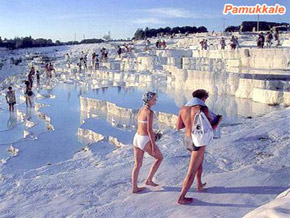 |
Pamukkale translated means “Cotton Castle”, and when you visit this truly
amazing phenomenon you will see why.
The hot springs are said to have healing properties and are recommended for
people who are suffering from heart disease, circulatory problems, high blood
pressure, nervous disorders and physical exhaustion.
According to scientists, if the water had always flowed at this rate, the
terraces must have begun to form 14,000 years ago.
Combined with the breathtaking sights of the calcified terraces and the warm
open air thermal pools to bathe in, Pamukkale is most definitely worth seeing
whilst visiting Turkey.
|
